
Who Really Tells the Story of How People Move in Africa? Why We Can’t Just Lump Sub-Saharan Data into "EMEA" Anymore
The standard blueprint for analysing global talent mobility follows a familiar, and frankly exhausted, routine. Most industry assessments slice the world into the usual geographic blocks: North America, Europe, and Asia-Pacific, eventually landing on a broad, catch-all bucket known as the Middle East and Africa, or "MEA." In larger corporate environments, this is stretched even further into "EMEA"—a designation that somehow manages to bridge the gap between the North Sea and the Cape of Good Hope. It is an incredibly expansive label that makes little sense when you actually look at the ground. When intelligence is aggregated, insight is diluted.
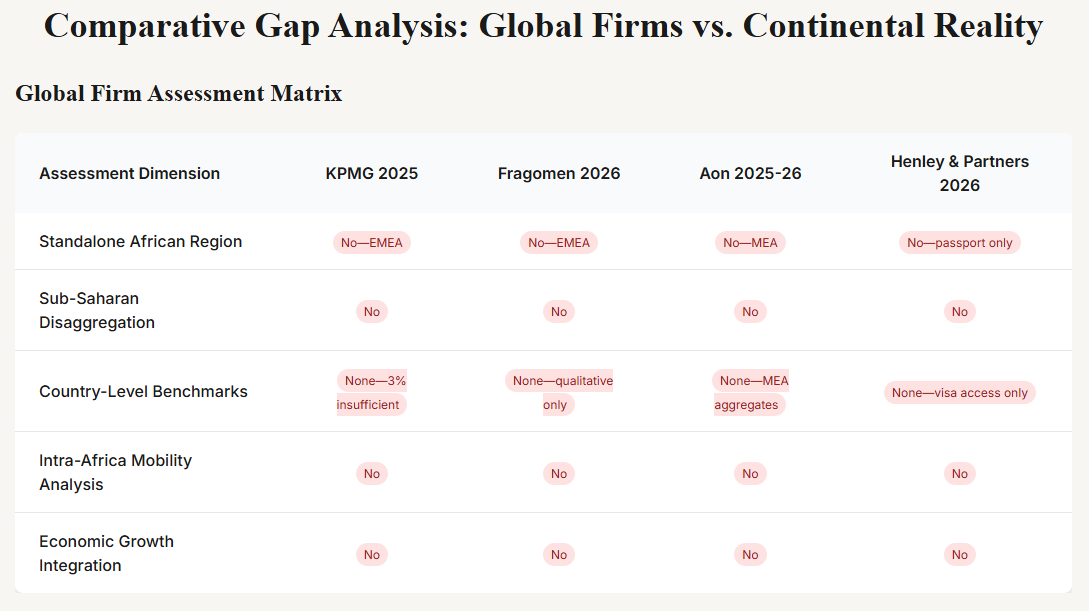
The image presents a structured comparison table titled “Comparative Gap Analysis: Global Firms vs. Continental Reality.” It is formatted as a Global Firm Assessment Matrix evaluating four major global mobility intelligence sources — KPMG 2025, Fragomen 2026, Aon 2025–26, and Henley & Partners 2026 — across five critical assessment dimensions relevant to Sub-Saharan Africa.
The Aggregation Problem
While these neat, sanitized spreadsheets suggest a logical approach to international business, they reveal a massive disconnect from the reality of the continent. Sub-Saharan Africa is home to 48 distinct nations and a population of over 1.2 billion people; it is the furthest thing from a monolith. This region contains major economic powerhouses and some of the fastest-growing markets on the globe. Shoving this staggering diversity into a secondary sub-category doesn't just oversimplify things—it actively erases the actual narrative of growth. This habit of grouping effectively buries the granular, day-to-day data that actually dictates whether a cross-border operation succeeds or fails.
To be clear, organizations like Fragomen, Aon, KPMG, and Henley & Partners do essential work. Their global reports are necessary for deciphering complex legal frameworks and compliance standards. Their research offers a strong foundation for understanding how talent moves through established economic corridors. The effort these firms put into tracking international trends provides a vital baseline for the global community, and their contributions remain an important piece of the puzzle.
However, the very structure of these global reports puts Sub-Saharan Africa at a disadvantage. By folding the region into massive EMEA or MEA aggregates, the specific intricacies of the continent are often reduced to a few bullet points on rules and regulations. Discussions about Africa usually only reach the surface when there is a major political shift or a crisis, which unfortunately frames the entire conversation around "risk" rather than the actual, routine mechanics of moving talent. It is a bit like only paying attention to a country’s climate during a natural disaster.
This systemic gap isn't usually a conscious effort to ignore the continent, but rather a legacy of how international data systems were built decades ago. The result, however, is a persistent shortage of the tools modern decision-makers actually need. Right now, the market lacks a comprehensive, data-driven study that compares corporate mobility specifically within the Sub-Saharan context. There is no definitive index to rank the ease of relocating talent across these specific borders, no standardized way to track policy shifts, and a glaring absence of major reports led by local experts to guide the global conversation. Africa shows up in these big reports, sure, but it rarely gets the depth of study its economic weight demands.
Why This Matters Now
The reality is that the continent is no longer a peripheral player in the story of global investment. Nigeria, South Africa, Kenya, Ghana, Angola, Ethiopia, and Botswana have become massive hubs for tech, energy, manufacturing, and infrastructure. Intra-African trade is also hitting new heights, fuelled by the integration goals of the African Union and the African Continental Free Trade Area (AfCFTA).
These massive economic shifts require a tracking mechanism that matches their scale. For multinational companies, the lack of localized data creates expensive operational blind spots. Without specific, regional insights, companies are forced into a guessing game regarding how long a work permit might take or how strictly certain regulations are actually enforced in practice. They struggle to accurately forecast costs and lack a reliable map for moving their people efficiently between African markets.
Governments face their own hurdles, as the absence of comparative data makes it hard to see how their own policies measure up against their neighbours. Consulting firms, held back by these broad geographic groupings, find it difficult to give the specialized advice clients need to enter these markets with confidence. The speed of Africa’s transformation has simply left the old way of tracking it in the dust.
The Cost of Analytical Erasure
When Sub-Saharan Africa is tucked away in a corner of a 200-page EMEA report, the vital local details are the first things to go. It becomes nearly impossible to tell if a new legislative change is working or to identify which countries are genuinely creating the most seamless business environments. The internal migration patterns within the region remain largely invisible, as does the sheer complexity of navigating different regulatory landscapes side-by-side.
A company deciding whether to invest in Nigeria, Kenya, or South Africa needs more than a summary paragraph in a global pamphlet. Strategic planning requires hard numbers, realistic timelines, and sector-specific risk profiles. Simply acknowledging that Africa is "growing" is not a strategy; building a real plan requires the precision of localized data.
From Reaction to Origination
Global enterprises have certainly noticed Africa’s potential, but the responsibility for telling the story of African mobility has to shift to those who are actually operating within the continent. This shift doesn’t mean we throw away the expertise of global firms—they provided the starting point. It’s about finally finishing the picture with a more focused, indigenous perspective.
As these economies become more intertwined, we have to stop viewing the continent as a single, uniform block. Every country’s data needs to be picked apart, every policy change needs to be understood, and every regional corridor needs to be mapped out. Linking economic growth directly to the demand for work permits and talent movement is the only way to ensure Africa is treated as a central pillar of the global economy, not just a footnote.
Introducing the Africa Global Mobility Intelligence Report 2026
In response to this structural gap, Ostabet Africa developed the Africa Global Mobility Intelligence Report 2026. This framework, driven by experts on the ground, focuses entirely on Sub-Saharan economies.
It introduces new, original metrics, including:
A Mobility Efficiency Index
A Policy Volatility Score
Compliance Complexity benchmarking
Processing time distribution analysis
Intra-Africa corridor mapping
Sector-specific mobility insights
Economic modelling aligned with 2026–2028 projections
This approach moves away from the idea of Africa as an "add-on" to another region and treats it as a complex, independent system. The goal isn't to knock the existing global reports, but to create a new standard of data that reflects the actual importance and complexity of the continent today.
What This Means for Corporate Leaders and Policymakers
For multinational corporations, this level of detail supports:
Investment prioritisation
Compliance risk forecasting
Talent mobility strategy
Budget modelling
Expansion sequencing
For African governments, the comparative data enables:
Regulatory reform targeting
Competitiveness measurement
Investment attractiveness signalling
Policy predictability enhancement
The fundamental shift is this: Africa should no longer be lumped together; it must be analysed on its own terms.
The Way Forward
As capital and commerce continue to move toward Sub-Saharan markets, the ways we track that movement have to keep up. The Africa Global Mobility Intelligence Report 2026 is the start of a more structured, serious approach to measuring success here. We don’t need to ask if Africa belongs in the global conversation anymore. The real question is whether the rest of the world will keep looking through a narrow lens or finally see the complex, high-speed region it has become.
The full report is now available. The story of African mobility is too important to be generalized, and the work of measuring it with precision is finally underway.